
A homeowner in Florida opens an insurance renewal notice and sees another sharp increase in premiums. Across the country, a distribution center slows operations after severe flood damage cuts off access roads. In California, another wildfire season forces communities to revisit evacuation plans, emergency power, and basic services. None of these moments show up in a stock market chart, but each shapes how real estate functions day to day. Those stories now sit on top of a broader pattern.
NOAA reports that the United States experienced 27 separate weather and climate disasters causing more than 1 billion dollars in damages in 2024.1 Over the same period, Swiss Re estimates that global insured catastrophe losses remained above 100 billion dollars for the fifth consecutive year.2 Not every event touches every property, but together they are influencing how insurers, lenders, municipalities, and investors evaluate physical risk.
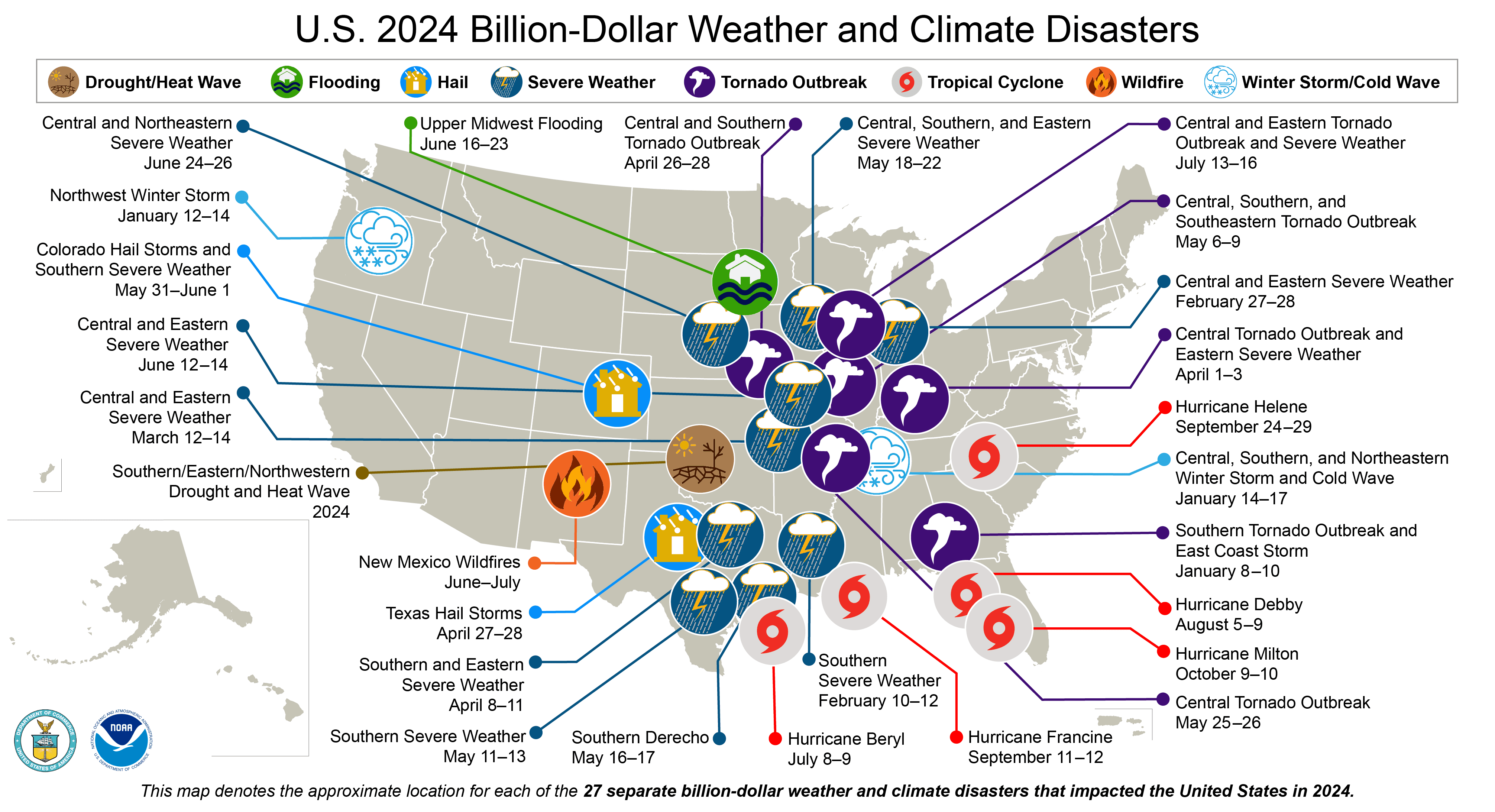
Source: 2024: An active year of U.S. billion-dollar weather and climate disasters. Smith. January 10, 2025.
For advisors, that context explains why climate related questions are showing up in client meetings, even when clients are not asking for “climate strategies” by name. The discussion is shifting from abstract concern about the environment to very practical questions about insurance costs, infrastructure strain, property values, and community resilience.
Moving past “Isn't This Just ESG?”
Many clients put any climate-related discussions into an ESG bucket the moment they hear the word. That reflex misses what is actually at stake in real estate: physical assets anchored to specific locations that cannot be moved if conditions deteriorate. A warehouse, apartment complex, office building, or self storage facility is located in a defined place with specific exposures, flood risk, fire risk, grid reliability, transportation access, and local infrastructure investment. The question is not whether a REIT publishes a sustainability report; the question is whether the properties it owns may face risks that insurers, lenders, engineers, and municipalities already measure and price.
How Insurance Starts Telling the Story
Insurance markets give advisors a practical entry point into physical risk. Carriers have spent decades refining catastrophe models to estimate how often events such as hurricanes, floods, wildfires, severe convective storms, and extreme heat might occur and how severe they may be. Clients feel those models indirectly through rising premiums, tighter coverage, and changing deductibles. For property owners and REITs, these changes feed directly into operating expenses, cash flow stability, and sometimes even decisions to reinvest or exit certain locations.
Why Two Buildings Can Face Very Different Futures
Clients may think in broad regional terms, “Florida is risky” or “the Midwest is safer.” A more useful way to explain real estate risk is at the property level. Two industrial facilities in the same state can sit on very different footing. One may sit outside a floodplain, benefit from modern construction standards, and connect to resilient roads and utilities. The other may face recurring exposure to flooding, aging infrastructure, or single-point-of-failure access routes.
The same idea holds across sectors. An apartment building's resilience may depend on drainage systems, emergency preparedness, and municipal investment in local infrastructure. Logistics facilities may rely heavily on transportation networks and reliable power supply. Data centers increasingly rely on consistent energy and water systems to keep operations online
Advisors can use these examples to help clients see that “real estate risk” is not a single number tied to a zip code. It is a set of conditions around individual properties that can evolve over time.
The Infrastructure Beneath the Investment
Real estate does not operate in isolation. Every property depends on a network of systems that determine how effectively a community functions before, during, and after an adverse event: roads and bridges, power grids, water systems, telecom networks, flood defenses, and emergency response capabilities.
Research supported by FEMA and the National Institute of Building Sciences has consistently shown that investments in hazard mitigation can generate multiple dollars of future savings for every dollar spent.3, 4 While outcomes may vary by project, the broader takeaway lesson is clear enough for client conversations: infrastructure resilience has economic value.
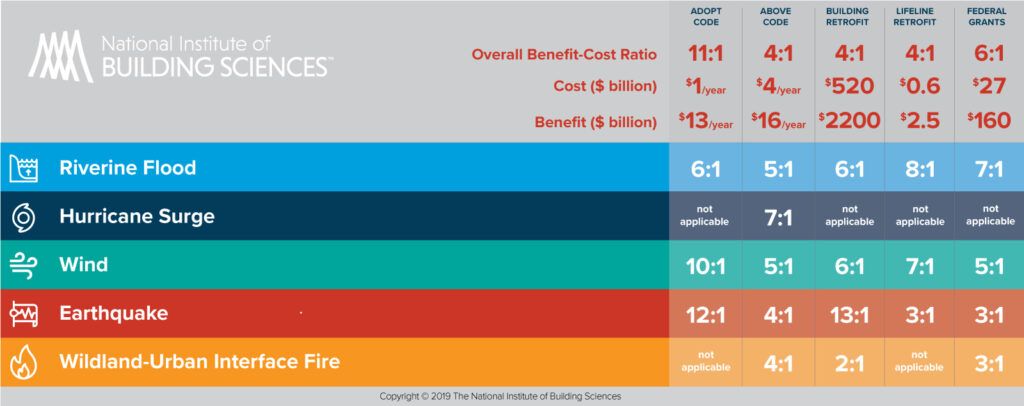
Source: National Institute of Building Sciences. December 2, 2020
For long-term investors, this means the sturdiness of surrounding systems may shape a property’s operating environment as much as what happens inside its walls. Advisors can position climate resilience as part of a broader discussion about economic durability and community strength.
Moving From Awareness to Allocation
At some point, clients turn to the portfolio: “What does all of this mean for my real estate exposure?
The answer is rarely to walk away from traditional REIT exposure altogether. Instead, advisors can treat climate resilient real estate as an additional lens for evaluating existing allocations. Traditional real estate indexes often weight holdings by market capitalization. Climate aware approaches can incorporate added information at the property level—physical risk, resilience characteristics, and the infrastructure context around those assets.
In practice, this means assessing REIT exposure with the same discipline clients already expect: occupancy, balance sheet strength, sector dynamics, interest rate sensitivity, and now, the physical and infrastructure risks that are increasingly visible in everyday life.
No methodology removes uncertainty. Real estate investments remain subject to market risk, rate moves, sector concentration, model limitations, and the unpredictability of future weather and economic conditions. The objective for advisors is not prediction; it is helping clients understand how an emerging risk factor can be integrated into a thoughtful allocation.
Sources
1. NOAA National Centers for Environmental Information
"Billion-Dollar Weather and Climate Disasters"
https://www.ncei.noaa.gov/access/billions/
2. Swiss Re Institute
"Natural catastrophes caused USD 137 billion insured losses in 2024"
https://www.swissre.com/institute/research/sigma-research
3. FEMA
"Natural Hazard Mitigation Saves"
4. National Institute of Building Sciences
"Natural Hazard Mitigation Saves: 2019 Report"
Carefully consider the Funds’ investment objectives, risk factors, charges and expenses before investing. This and additional information can be found in the Fund’s Prospectus and Summary Prospectus, which may be obtained by visiting www.climateglobaletf.com. Read the Prospectus and Summary Prospectus carefully before investing.
The Fund is distributed by Foreside Fund Services, LLC. Exchange Traded Concepts, LLC serves as the investment advisor. The Fund is distributed by Foreside Fund Services, LLC., which is not affiliated with Climate Global, Exchange Traded Concepts, LLC, or any of its affiliates.
Investing involves risk, including possible loss of principal. The Fund’s return may not match or achieve a high degree of correlation with the return of the Index. To the extent the Fund’s investments are concentrated in or have significant exposure to a particular issuer, industry or group of industries, or asset class, the Fund may be more vulnerable to adverse events affecting such issuer, industry or group of industries, or asset class than if the Fund’s investments were more broadly diversified. Issuer-specific events, including changes in the financial condition of an issuer, can have a negative impact on the value of the Fund.
A new or smaller fund is subject to the risk that its performance may not represent how the fund is expected to or may perform in the long term. In addition, new funds have limited operating histories for investors to evaluate and new and smaller funds may not attract sufficient assets to achieve investment and trading efficiencies.
Shares are bought and sold at market price (closing price) not net asset value (NAV) and are not individually redeemed from the Fund. Market price returns are based on the midpoint of the bid/ask spread at 4:00pm Eastern Time (when NAV is normally determined) and do not represent the return you would receive if you traded at other times. Brokerage commissions will reduce returns.
