
Mention climate resilient real estate and many investors immediately assume the topic is ESG. The reaction—positive or negative—often depends more on personal attitudes than on the assets themselves.
That quick label can obscure a more direct question: what allows a real asset to keep operating, generating cash flow, and retaining value when conditions become more challenging? Answering that question is not about corporate slogans. It is about infrastructure and the systems that support economic activity.
Real Estate Sits on Infrastructure, not Just Land
Real estate is often discussed as a collection of buildings, office towers, apartment complexes, logistics facilities, data centers. Yet the value of those assets depends on the networks around them.
A logistics hub without reliable highways and rail access loses much of its purpose. A data center with a fragile power supply or cooling capacity becomes a liability. Residential communities that experience repeated infrastructure disruptions may face very different long term outcomes than those backed by stable, well maintained systems.
Seen this way, real estate is a web of assets embedded in broader economic networks rather than isolated structures. As infrastructure itself rises on the investment agenda, understanding that connection becomes more important for long horizon investors.
The American Society of Civil Engineers’ 2025 Infrastructure Report Card estimates a multi trillion dollar investment gap in U.S. infrastructure over the next decade, even after recent public and private initiatives.1, 2 Those figures highlight that critical systems are both in need of capital and central to economic performance.
Operational Continuity as the Core of Resilience
Markets have always rewarded assets that remain functional under stress. Businesses value facilities that stay open. Tenants value reliability. Investors value cash flows that are less exposed to disruption.
Viewed through this lens, climate resilience becomes an operational question:
Can the property continue to function when conditions deteriorate?
Can tenants and workers access it?
Can utilities support it without extended outages?
Can surrounding infrastructure recover at a reasonable pace after disruption?
None of these questions are new. What has changed is the level of detail now available to answer them. Investors can increasingly evaluate property‑level risk characteristics, local infrastructure conditions, and evolving physical exposures with a precision that was difficult even a decade ago.
That evolution mirrors how another industry has approached risk for years: Insurance.
What Insurance Markets Prices into the System
Long before climate resilience entered mainstream investment conversations, it was central to insurance underwriting. Insurers use catastrophe models to estimate the likelihood and severity of events such as hurricanes, floods, wildfires, and severe convective storms—and to translate those estimates into economic terms.
Recent work from Swiss Re suggests that global insured losses from natural catastrophes have remained above 100 billion dollars annually for multiple years, with 2024 losses near 137 billion dollars.3, 4 The drivers include asset concentration, rebuilding costs, and changing exposures rather than any single narrative.
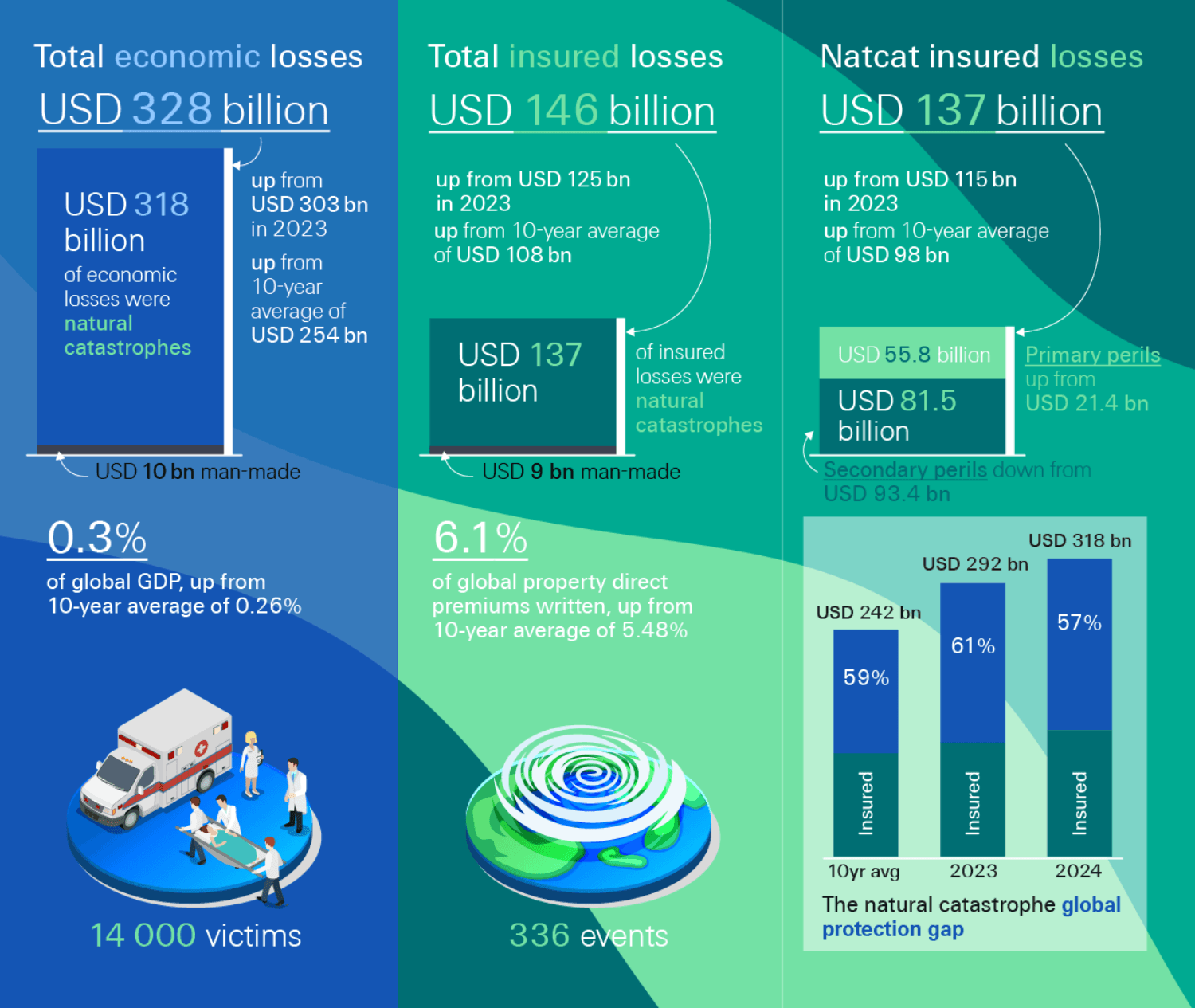
Source:Swiss Re Institute "Natural catastrophes: insured losses on trend to USD 145 billion in 2025"
Insurers are not voting on ideology; they are pricing risk. When they adjust premiums, revise coverage, or reconsider exposure in certain regions or asset classes, they are responding to signals about expected losses.
For investors, those signals matter even if they disagree with any particular decision. Insurance pricing influences operating expenses, financing conditions, and sometimes the viability of maintaining or expanding assets in certain locations. It offers a disciplined framework for discussing climate resilience as an economic issue, not a branding issue.
Resilience as a Source of Economic Value
Resilience is not a theoretical concept. Research by the National Institute of Building Sciences, supported by FEMA, has shown that hazard mitigation investments can generate several dollars in benefits for every dollar spent.5, 6 Specific outcomes differ, but the broader point holds: investments that reduce the likelihood or impact of disruptive events can create measurable economic value.
The same logic applies across real estate markets. A property backed by reliable infrastructure and thoughtful mitigation may encounter a different pattern of operating conditions than one facing recurring disruptions. Communities that invest in flood protection, grid modernization, water systems, or emergency preparedness build different risk profiles than those that defer such investments.
None of this guarantees performance. It does, however, reinforce a principle investors already understand from other domains: durable assets often derive their durability from the systems around them.
Why This Framing Reaches Skeptical Investors
Advisors frequently meet investors who disengage as soon as a conversation is framed around climate themes or sustainability labels. Those same investors may be comfortable evaluating infrastructure quality, operational risk, insurance markets, and economic resilience.
Climate resilience can be discussed in those familiar terms. Most investors do not judge a property solely by how it looks. They examine occupancy, management, financing, demographics, and market dynamics. Adding an infrastructure and physical risk lens fits naturally into that process.
When framed this way, the conversation becomes less about preferences and more about understanding additional factors that can influence long term real estate economics. Climate resilient real estate is simply an attempt to make those factors explicit.
A Different Way to Think About REIT Exposure
Traditional REIT indexes have historically emphasized market capitalization and sector weights. Climate-resilient approaches seek to add another layer of analysis.
Rather than solely evaluating the companies that own properties, these approaches may incorporate information about the properties themselves: physical risk exposures, resilience characteristics, and the infrastructure context in which they operate. This gives investors a way to align REIT exposure with views on long-term operational durability and infrastructure risk.
Any such methodology comes with limits. REITs remain subject to equity market risk, interest rate sensitivity, sector concentration, model risk, and the inherent uncertainty of future weather and economic conditions. The goal is not to remove risk; it is to understand how physical and infrastructure factors may shape outcomes over time.
For investors wary of ESG framing but focused on economic resilience, this lens offers a different path: treat climate resilient real estate as an infrastructure driven, risk aware way to evaluate exposure—not as a values screen.
Sources
1. American Society of Civil Engineers (ASCE)
2025 Report Card for America's Infrastructure
https://infrastructurereportcard.org/economics/
2. American Society of Civil Engineers (ASCE)
"5 Key Takeaways from the 2025 Report Card for America's Infrastructure"
3. Swiss Re Institute
"Natural catastrophes: insured losses on trend to USD 145 billion in 2025"
4. Swiss Re Institute
"Hurricanes, severe thunderstorms and floods drive insured losses above USD 100 billion for fifth consecutive year"
5. Federal Emergency Management Agency (FEMA)
Mitigation Saves Fact Sheet
https://www.fema.gov/sites/default/files/2020-07/fema_mitsaves-factsheet_2018.pdf
6. National Institute of Building Sciences
Natural Hazard Mitigation Saves Study
Carefully consider the Funds’ investment objectives, risk factors, charges and expenses before investing. This and additional information can be found in the Fund’s Prospectus and Summary Prospectus, which may be obtained by visiting www.climateglobaletf.com. Read the Prospectus and Summary Prospectus carefully before investing.
The Fund is distributed by Foreside Fund Services, LLC. Exchange Traded Concepts, LLC serves as the investment advisor. The Fund is distributed by Foreside Fund Services, LLC., which is not affiliated with Climate Global, Exchange Traded Concepts, LLC, or any of its affiliates.
Investing involves risk, including possible loss of principal. The Fund’s return may not match or achieve a high degree of correlation with the return of the Index. To the extent the Fund’s investments are concentrated in or have significant exposure to a particular issuer, industry or group of industries, or asset class, the Fund may be more vulnerable to adverse events affecting such issuer, industry or group of industries, or asset class than if the Fund’s investments were more broadly diversified. Issuer-specific events, including changes in the financial condition of an issuer, can have a negative impact on the value of the Fund.
A new or smaller fund is subject to the risk that its performance may not represent how the fund is expected to or may perform in the long term. In addition, new funds have limited operating histories for investors to evaluate and new and smaller funds may not attract sufficient assets to achieve investment and trading efficiencies.
Shares are bought and sold at market price (closing price) not net asset value (NAV) and are not individually redeemed from the Fund. Market price returns are based on the midpoint of the bid/ask spread at 4:00pm Eastern Time (when NAV is normally determined) and do not represent the return you would receive if you traded at other times. Brokerage commissions will reduce returns.
